Kitesurfing (also kiteboarding) is one variation of surfing, i.e. riding a board over waves. Classical surfing uses just a board, windsurfing uses a board with a sail, while kitesurfing uses a board and a kite that is somewhat reminiscent of a paraglider.
Kitesurfing is a relatively young sport, but it has quickly won its place on beaches around the world, including in Poland. It is worth noting that the discipline used to be counted among extreme sports. Currently, with the rapid development of technology and improved safety of equipment, anyone can become a kitesurfer. Even advanced age is not an obstacle, general physical fitness is sufficient.
In order to practice kitesurfing, you need the right equipment, viz:
– A board with a small displacement. When thrown on the water it will stay on the water, but under the weight of a person it will go to the bottom. Two types of boards are used in kitesurfing: twin-tip and directional. The former have the same tip on both sides and allow you to swim in both directions. The latter are shaped like surfboards and are mainly used for racing and wave riding.
– Bar, which is the harness to which the trapeze and kite are attached. Depending on the type, it can resemble a seat used by a kitesurfer or a belt fastened around the hips. In each case, the bar is connected to the trapeze by ropes.
– The kite, a kind of propulsion source. The wind caught in the kite allows the kitesurfer to stay on the surface of the board and to make it glide across the water. Kites are produced in several versions and sizes, the largest ones being used by advanced kitesurfers. The kite is selected not only according to the skill of the athlete, but also according to their weight. Children by nature benefit from smaller kites. The same are also offered to people who are just learning to kite board. It is worth noting that it is actually not the board but the kite that keeps the kitesurfer above the surface of the water.
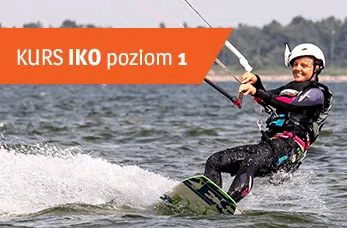
Learning to kitesurf takes place on IKO courses. The three-step course allows you to learn all the ins and outs of kitesurfing. Thus:
IKO I – the first level of initiation is first and foremost to get acquainted with the equipment, its construction and to learn the rules concerning safety when practising water sports. The kitesurfing adept learns the correct handling of the equipment, how to fold the kite, how to roll the bar, takes the first steps on the water, learns the techniques of swimming on the board and restarting the kite from the water. He also learns how to judge the direction of the wind relative to land.
IKO II – is a step towards independence. The kitesurfer learns to take off, swim a short distance and stop in a controlled manner. He or she learns how to recover the board on the water and how to emergency fold the kite and reel the lines.
IKO III – is a course for those who have mastered the basics of kitesurfing in practice. The third level of the course is about learning how to sail hard into the wind, gaining and maintaining height, making turns. The experienced kitesurfer learns how to swim the board in deep water and how to react correctly in difficult situations.
Kitesurfing is a fashion that came to us from the beaches of warm oceans, but has also taken root on the Baltic Sea. Kitesurfers can be found, among others, on the Hel Peninsula, in Jastarnia, Jurata, Chałupy, Mielno, Kołobrzeg and Rewa. The Baltic does not impress with its high water temperature, but it has other important assets for kitesurfers. It attracts favourable winds and relatively shallow water. Due to the possibility of accidents, the sandy bottom is also ideal. Kitesurfers can most often be seen in the Bay of Gdansk area.